
Type
blogs
Scope of Work
Civic Education & Empowerment
Issue
Inclusive economy, Women's entrepreneurship
The Joy of Being Connected Ignites Women to Thrive in the Digital Economy
Nina Asterina
Tue, 10 Mar 2026

8 min read
by Nina Asterina and Bima Pratama Putra
“Women can thrive in business while still embracing their roles as mothers and wives. What matters most is the courage to start and the spirit to keep going.” - Rustini.
For many women in Indonesia, entrepreneurship begins at home.
Across the country, women own 64.5% of its 65 million micro, small, and medium enterprises (MSMEs)—a sector that contributes 60.51% of national GDP and employs 97% of the workforce. Entrepreneurship transforms women’s roles within their families and communities. Women-led businesses not only support their families financially but also create new economic opportunities for their neighbors or local groups in small-scale production or distribution. Having their own source of income builds their confidence and gives them a stronger voice in family decisions. It also enables them to take an active role in contributing to society, negotiate spaces, and earn recognition in communities, becoming not only a source of income but also a tool of empowerment.
The realities of home-based women entrepreneurs
Despite their significant contributions, many home-based women entrepreneurs struggle to keep pace with rapid digitalization. Many often do not leverage available technological tools due to a lack of digital skills, equitable internet connectivity, financial literacy, business networks, and market information. At the same time, limited time due to caregiving responsibilities hinders their ability to learn and keep up with the fast-changing digital economy landscape. This gap is often framed as a technical one: a lack of specific skills or knowledge that can be addressed through training. Yet we at Kota Kita have learned that the gap is not only technical but also social.
For many women entrepreneurs, running a business from home can be a lonely journey. With limited opportunities to meet peers, exchange ideas, or access broader business ecosystems, they may struggle to obtain market information, improve their products, or navigate digital platforms that could help them grow their business. Connection and collective learning are therefore particularly essential. Through networks, women entrepreneurs can access knowledge and markets, share experiences and skills, and receive the emotional support needed to sustain their businesses. In this way, networks can transform home-based entrepreneurship into collaborative ecosystems where women support one another as they navigate the rapidly evolving digital economy.
What does it mean to be connected?
This has been our key learning in implementing the DIVA¹ program. Across Solo, Klaten, and Karanganyar, women entrepreneurs are finding new ways to participate in the digital economy, thanks to DIVA. DIVA isn’t just a training program. It’s a breath of fresh air for over 450 women, giving them the safe space to learn, unlearn, and relearn what it means to run a business online.
Our learning journey began with a simple question: What does it mean to be connected?
In the spaces fostered by DIVA, many women — regardless of age, ability, or where they live — bonded over shared challenges. Most of the women joining the DIVA program didn’t know how to connect to the digital world or what it would take to keep their businesses alive at the beginning. Many were still using outdated smartphones that ran out of storage or crashed when they tried to do even the simplest things. Some were sharing their phones with family, which makes managing emails and passwords even more confusing.
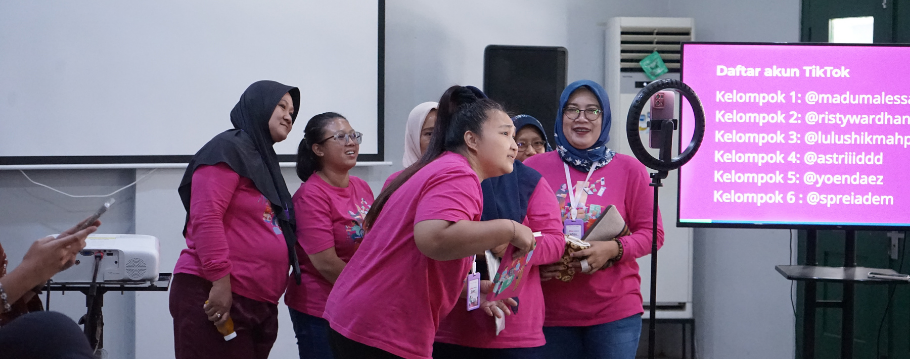
But here’s the good news: all of these women also share the same drive to grow and succeed. With patience, courage, and solidarity, they navigated the challenges of adapting to unfamiliar technology and processes to try new digital tools. In this aspect, DIVA provided a safe space where women don’t feel embarrassed to learn new things. Instead, it makes them feel proud of their progress. Supported by hands-on training, genuine mentors, and peer knowledge exchange, these women entrepreneurs saw setbacks not as failures but as opportunities to grow.
“Growing together brings far more joy than succeeding alone.” – Ludovica.
What began as a simple question when DIVA first set out on its journey has revealed an equally simple, practical answer. For home-based women entrepreneurs, digitalization starts with small steps; it’s things like promoting products on WhatsApp status, switching to WhatsApp Business to set up a chatbot and business hours, or even just tagging their business on Google Business so customers know they exist. All of these help them juggle household responsibilities and customer needs. A lot of these ideas never even crossed their minds until they had access to digital literacy training. Now, they’re starting to see that learning how to take better photos or edit videos is just as important as redesigning their packaging, refreshing their brand, or telling their business story in a new way.
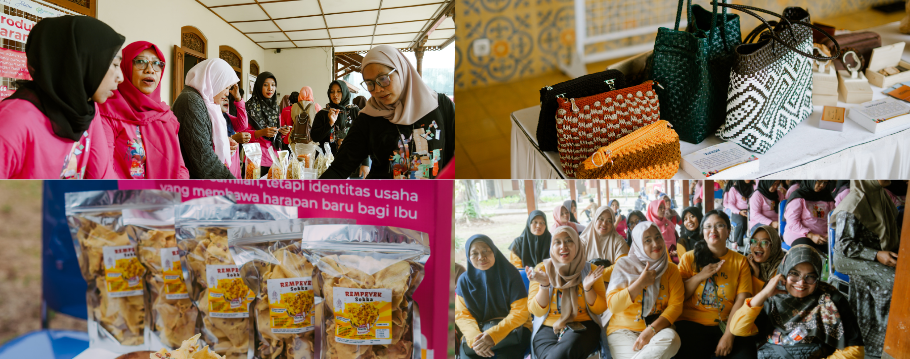
For instance, Daruki in Karanganyar, whose products are banana-leaf tempeh, said that learning and trying something new for her business has been a real joy from DIVA.
“I thought I might be too old to learn all these apps. I only heard about Canva because of DIVA. But to my surprise, my banana-leaf tempeh actually looks really nice in a good photo. I was even more amazed when a traveler showed up at my house, right in the middle of the rice fields, wanting to buy my tempeh after finding my location on Google Business,” Daruki recalled with a laugh.
Getting connected to the digital economy hasn’t just opened up new markets for Daruki; it’s also given her more confidence as a woman and as an entrepreneur. Now, she doesn’t see her disability, age, or village background as a barrier anymore.
As DIVA grows to be a supportive community, it’s changing the way women see themselves, not just as individuals, but as part of a community and as active citizens who are contributing to the wider economy.
You can discover more stories like Daruki’s and feel their joy in our impact report and on our YouTube channel. Visit our e-catalogue at divaumkm.id to support their growth.
Footnote
1. DIVA UMKM (DIVA) is a digital literacy and capacity-building program by Kota Kita and Jalatera, supported by the Internet Society Foundation. It provides training and mentorship for women entrepreneurs, with and without disabilities, in Solo, Klaten, and Karanganyar, Indonesia. Training modules and mentors are provided in partnership with Hetbanana-leaf tempeh, has found learning and trying something new for her business ero Space Solo.
References
United Nations Global Pulse. (2022). Futures of MSME: Horizon scanning report.
Antara News. (2024, January 12). Indonesia strengthens MSMEs as the backbone of the national economy. https://en.antaranews.com/news/380325/indonesia-strengthens-msmes-as-backbone-of-national-economy